Compression Check: Testing and Inspection
Compression Pressure, Checking
Special tools, testers and auxiliary items required
• Spark Plug Removal Tool (3122 B)
• Puller for Ignition Coil (T10095 A)
• Assembly Tool (T10118)
• Torque Wrench (5-50 Nm) (V.A.G 1331)
• Compression Tester (V.A.G 1763)
Test Conditions:
• The engine oil temperature is at least 30 °C (86 °F).
• The battery voltage must be at least 11.5 volts.
• All electrical consumers such as, for example, lights and rear window defogger, must be turned off.
• If the vehicle is equipped with Air Conditioning (A/C), it must be turned off.
• The selector lever must be in either the "P" or "N" position.
Test Sequence:
- Remove the fuse for the fuel pump control module from the fuse panel.
Voltage supply to the fuel pump is interrupted when the fuse is removed.
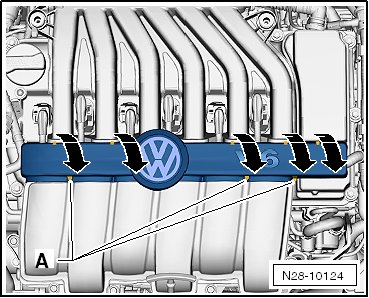
- Unclip the cover strip from the ignition wiring harness - arrows - and move it forward from the tabs - A -.
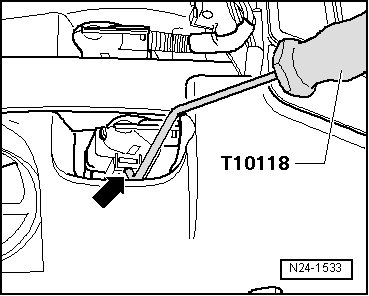
- Using the assembly tool (T10118) , press the release button - arrow - and carefully pull the connector up.
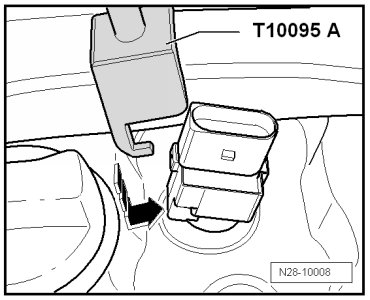
- Slide the puller for ignition coil (T10095 A) onto the flat side of the connection in the - direction of the arrow - and pull out the ignition coil with power output stage.
- Remove the spark plugs using spark plug removal tool (3122 B).
- Check the compression using the compression tester (V.A.G 1763).
• Using the compression tester, refer to the operating instructions.
- Have a second technician crank the engine long enough until the tester shows there is no increase in pressure.
Compression Pressure:

- Install the spark plugs using the spark plug removal tool (3122 B) and tighten them to 18 Nm.
- Install the ignition coil with output stages. Refer to => [ Ignition Coil with Power Output Stage ] Service and Repair.
After the compression test is completed:
- Connect the Vehicle Diagnostic Tester.
- Perform a vehicle system test. Refer to "Guided Fault Finding" in the Vehicle Diagnostic Tester.
- End the vehicle system test in such a way that any possibly existing Diagnostic Trouble Code (DTC) entries are automatically erased.
- Create the readiness code with a road test.
Always observe all safety precautions when performing the road test.
- Perform a vehicle system test again after the road test and correct any faults.